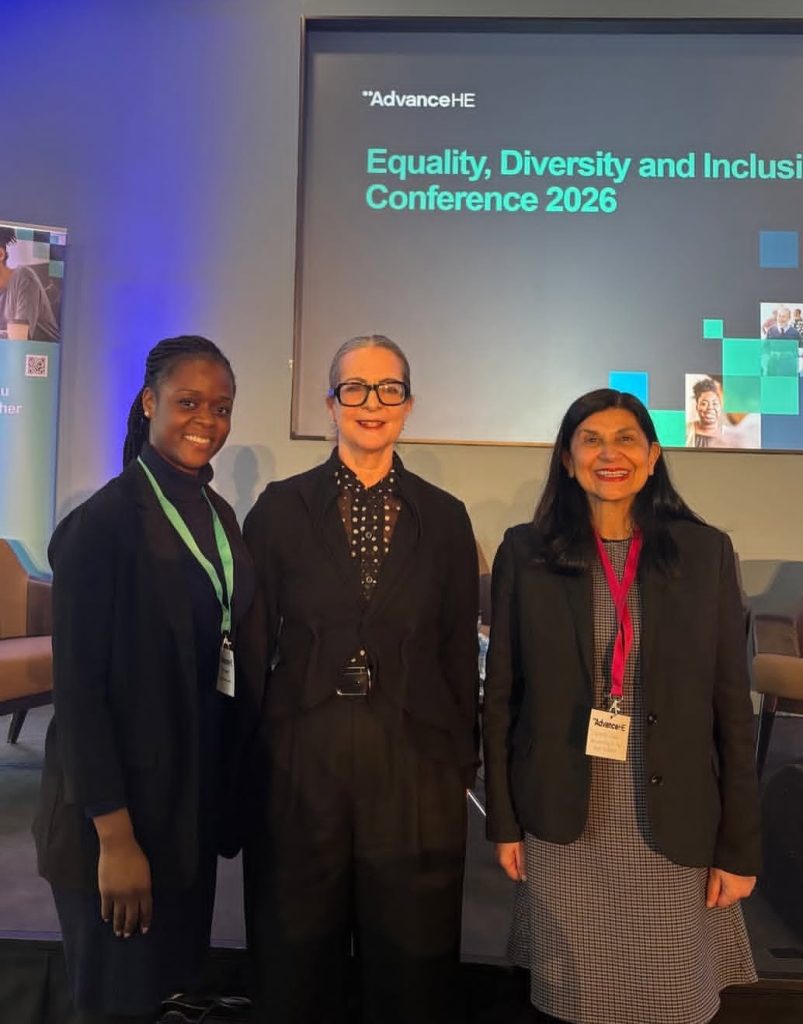
On Wednesday 25 March, I was pleased to take part in a panel on Courage and Pragmatism at the Advance HE Equality, Diversity and Inclusion Conference.
Chaired by Alistair Jarvis, CEO of Advance HE, the session brought together a range of perspectives. We heard a powerful keynote from Donna Whitehead , Vice-Chancellor of the University of Brighton, and I was joined on the panel by Zainab Khan from London South Bank University.

It was a timely and thought-provoking discussion.
Across the session, we reflected on the realities facing universities today: significant financial pressures, increasing regulatory complexity, and a political climate that is, at times, uncertain and challenging. These pressures are not abstract. They are shaping institutional priorities and, in some cases, raising difficult questions about how equality, diversity and inclusion is positioned and sustained.
We discussed the Office for Students’ approach to regulation and freedom of speech, the persistence of the attainment gap despite sustained effort, and the ongoing need to ensure that our staff communities better reflect the students we serve.
What became clear is that the current context is having a chilling effect on leadership. At a time when EDI is being rolled back or reframed in parts of the corporate world, university leaders are having to navigate increasingly complex terrain.
So the question becomes: how do we hold our nerve?
For me, one of the most important points from the discussion was that inclusivity is easy to say and hard to do. That has always been true. When I was a student in the 1980s, racism and inequality were widespread, but there was also a strong sense of optimism and a collective ambition to build a more equal society.
Today, it can feel as though some of that progress is being tested, even undermined. But perhaps this moment asks something of us. How much do we care? And how prepared are we to keep going?
Progress is never linear. The challenge now is to adapt our tactics while holding firm to our purpose.
We know that inclusive institutions are not an optional extra. They are fundamental to student success and to thriving communities. The question is how we continue to make that real in a time of constraint.
That requires honesty. We need to be clear-eyed about where we are, interrogate our data and strategies more rigorously, and be willing to change what is not working.
It also requires us to think differently about how we teach, how we support learning, and how we understand our role in our local communities and regions. Leadership matters here, but not only at the top. Each of us has a role to play in shaping inclusive cultures.
There is also a wider challenge we cannot ignore. The rise in young people who are not in education, employment or training should give us pause. Too many are disengaging. Universities must ask themselves how they remain relevant to all young people, whatever their background or circumstances.
This is where lifelong learning becomes critical. We need to address missed opportunities, support reskilling and upskilling, and demonstrate clearly how universities contribute to everyday life in our communities and wider society.
That may require us to rethink not only our institutions, but also our own roles within them.
We are being asked to do more with less. But universities still have something powerful to draw on: ingenuity, creativity and intellectual rigour.
In a period of flux and challenge, those qualities matter more than ever.
And if we are serious about keeping equality, diversity and inclusion at the heart of what we do, then all voices and all perspectives must be part of shaping what comes next.

Leave a Reply